Bluff Club: A One Phone Party Game About Finding the Faker
Party games have a setup problem. The good ones need a box, cards, and somebody who already knows the rules explaining them for ten minutes while the mood drains out of the room. The app versions usually fix that by asking everyone to install the same thing and join a lobby, which is its own ten minutes.
So I built Bluff Club, a social deduction party game that runs on one phone for three to twelve people. You type in names once, pass the phone around for private reveals, and the app handles the rest: turn order, the discussion timer, the voting screen, the reveal and the score. It is on the App Store now.
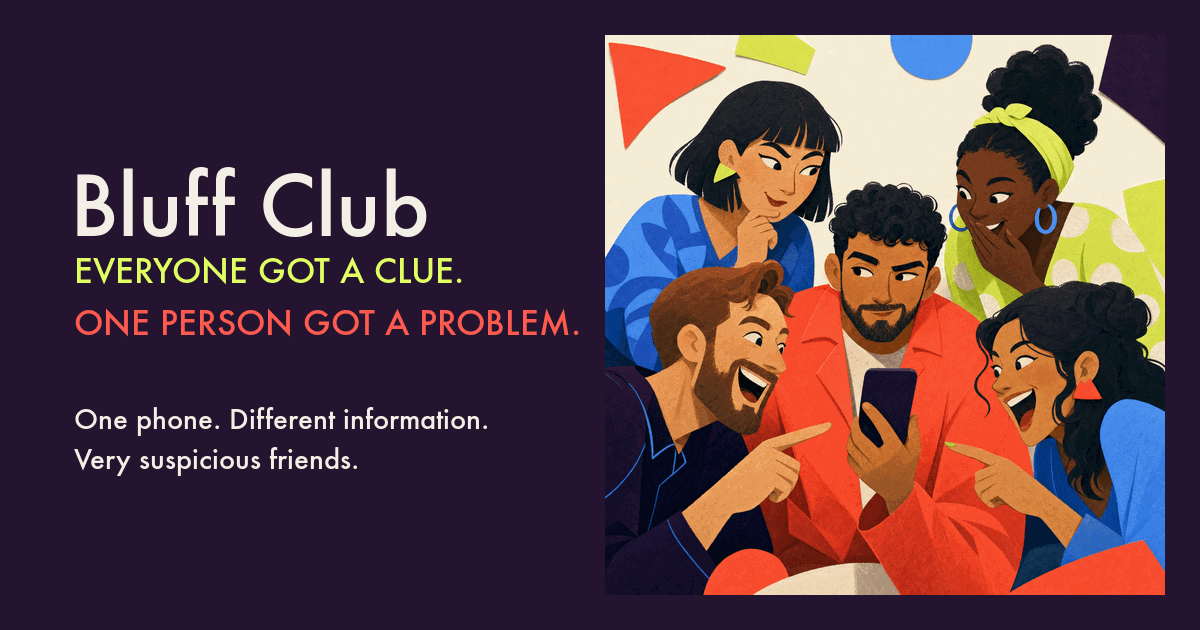
The one idea the whole game runs on
Every mode does the same thing: it secretly gives one player different information from everyone else, then asks the group to find them by listening to how people talk.
That is the trick that makes it more than an Imposter clone. Imposter is the familiar version, where most people get a secret word and one person only gets the category. But the mismatch does not have to be a missing word. It can be a different question, or a hidden agenda, and each of those produces a completely different conversation from the same engine.
- Imposter. Everyone gets the secret word. The Faker gets only its category. Each player gives one short clue, then the group votes. If the Faker is caught, they get one guess at the word to steal the round back.
- Wrong Question. Everyone answers a question out loud, but one player was shown a subtly different one. "What animal would make the worst flatmate?" against "What animal would make the best bodyguard?" Several answers fit both, which is the point. The reveal shows both questions next to everybody's answer, and that is usually the funniest screen in the app.
- Rigged Ranking. The group has to agree on an order for four or five items. One Saboteur has a private objective, like getting the rubber duck into the top two, and has to argue for it without looking like they are arguing for it.
- Party Mix. A 15, 30 or 45 minute session that rotates through the modes, spreads the hidden role around fairly, keeps a running scoreboard, and finishes with awards like Best Detective and Smoothest Liar.
Party Mix mattered more to me than adding a fourth or fifth mode. A pile of modes is a menu. A timed session with a scoreboard is an evening.
Nobody sits out
The design rule I would not bend: a vote resolves the round, not the player. There is no elimination, so the person who gets caught first is not stuck watching everyone else have fun for twenty minutes. Everybody is back in on the next round, which is roughly three to five minutes later.
The second rule was that the phone teaches the rules as you go. Each player gets the one instruction they need at the moment they need it, so there is no rules screen to sit through before the first round. If someone joins the group halfway through the night, they can pick it up on their turn.
The third was that the app should stay out of the way. The reveal gets animation and a sound cue, and then it shuts up, because the game is the six people arguing, not the screen.
Why this is not my other party app
I also have Chinwag, a pass-the-phone conversation game. Two party apps from one person invites the obvious question of why they are not one app with two tabs, so here is the honest answer.
They set up opposite expectations. Chinwag starts the second you pick a deck, and a good answer is whatever makes the room laugh. Bluff Club needs player names before anything happens, because roles, votes and scores all depend on knowing who is who, and the app decides who was right. Putting both behind one home screen would mean explaining two incompatible ways to play before you get to play either.
The content has different jobs too. A Chinwag prompt succeeds if it starts a good conversation. A Bluff Club paired question can be genuinely funny and still be unusable, because it makes the Faker obvious on the first answer. Same tooling, different acceptance test.
How it is built
Bluff Club is React Native on Expo in TypeScript, with no backend for gameplay. All 240 content cards, 96 Imposter words, 72 question pairs and 72 ranking scenarios, ship inside the app, so a round works on a plane, in a hostel with bad wifi, or with airplane mode on. Subscriptions go through RevenueCat. There are no accounts and nothing to sign up for.
The part I did not expect to spend time on was privacy in the physical sense. Half of this game is holding a phone that shows your secret role while five people lean towards you. The reveal and the private vote screen block screenshots and screen recording, and blur themselves in the iOS app switcher, using expo-screen-capture, which is one of those features nobody will ever compliment and everybody would notice if it were missing.
The content was drafted with an LLM and then checked by hand, which is the only part of the build I would call slow. A word pair that reads fine on screen can be dead on the table because one answer instantly gives the Faker away, or because it quietly assumes you grew up in one country. Every card got read with the question "does this actually produce an argument", and a lot of them did not survive it.
The marketing site is a separate small Next.js 16 app with React Server Components, deployed to Cloudflare Workers.
What is free
The free app is a real game, not a demo: Imposter, Wrong Question, the 15 minute Party Mix session and three content packs. Rigged Ranking gives you a free preview round before it asks for anything, and a subscription unlocks it fully along with the 30 and 45 minute sessions and three more packs. You can also type in your own Imposter words and category, so a group can point the game at their own in-jokes.
It has just launched on iPhone, so there is nothing to report yet about how it goes down with real groups beyond my own playtests. Android is built but not released.
Have a look at bluff-club.joshsalway.com, or get it on the App Store and find out which of your friends is a worryingly good liar.